
Why AI work needs a human in the loop
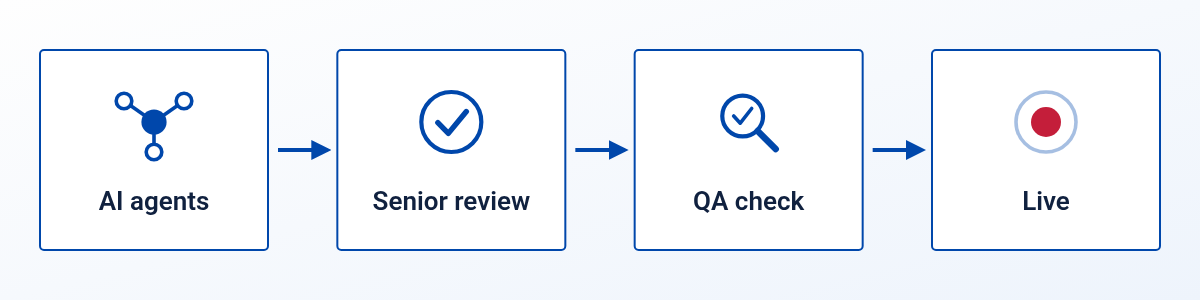
We review artificial intelligence (AI) work the same way for every client: AI agents research, write, design, and build, and a senior lead reviews and approves the work before anything goes live. Our own website shows that process in practice. Here, review caught real mistakes before they did harm: copy that made a person answer for results, dates that would age the page, a detail that could identify a partner, and security gaps. Below is what went wrong, how it was caught, and why we never give AI full control on any project.
| What AI did well | What review caught | What we changed |
|---|---|---|
| Fast research, drafting, layout, and build work across many pages | Wording that implied a personal guarantee, dated phrases, partner details, stale search text, and security gaps | Rules that reach every agent, a quality check after every page, and traceable changes |
How we built this site with AI and a human in the loop
You Go Media ran this website as a working test of the process we offer clients. Separate AI agents handled research, copy, search engine optimization (SEO), design, and web development. Each agent worked from a shared rulebook covering voice, legal wording, confidentiality, and search strategy. A senior lead reviews and approves the work before it ships, and a quality assurance (QA) check runs after every page.
That structure matters because AI is quick and confident, and it is not always right. It writes copy that sounds reasonable, follows patterns it finds in existing pages, and applies instructions exactly as given.
We kept a record of what went wrong. Across 15 documented incidents, the same pattern kept returning: the AI did useful work, and review caught what it missed. If you are weighing whether to let AI build your site on its own, this page explains why a developer still matters when AI can build a site. The sections below cover the confirmed incidents we can share publicly, what each one could have led to, and what we changed.
What the AI got wrong, and how review caught it
| What the AI did | How it was caught | What we changed |
|---|---|---|
| Wrote page and ad copy that made a named person answer for results | Senior review, then a QA and advertising audit | Rewrote the lines; QA now checks every page and asset |
| Reused banned wording in a link specification | The development agent stopped the task | New link text requested from search |
| Added dated phrases to body copy | Search clearance and a dedicated no-dates pass | Dates removed from body and search fields |
| Updated prices in the body but left an old search description | A development and branding sweep | Search description queued for correction; other pages checked |
| Named a partner’s city in copy and keywords | Senior review through QA | Reduced to state level; city dropped from keywords |
| Pointed national pages at a local page | Senior review | Built a location-neutral page and repointed links |
| Left abbreviations unexplained and dropped the Oxford comma | QA and a search abbreviation audit | Abbreviations spelled out; Oxford comma fixes verified |
| Overstated headcount with “team” language | Branding review | Each project has one lead, with specialists added as needed. |
| Carried an unsourced claim through drafts | Senior review | Claim marked superseded and removed |
| Applied a relayed instruction sitewide | Senior review soon after | Changes reverted; original wording restored |
| Could not explain a database reset | Senior review and a search regression check | 22 of 22 restored pages passed; change log installed |
Wording that implied a personal guarantee
Our AI wrote page and ad copy stating that a senior expert decides what ships and answers for the result. It sounded reassuring. A senior review flagged it, and an audit found 3 lines across 7 images and 4 text fields. We rewrote every line to say a senior expert reviews the work before it ships.
Left in place, wording like this could read as a personal promise of results in a dispute, and it might tie an individual to outcomes no one can control. A second incident showed the rule had to reach every agent: a link specification handed to development reused the banned wording, and the development agent stopped the task until new link text arrived.
Facts that age or go stale
An early draft cited studies and laws with the year attached. A no-dates pass removed them from the body and from the search fields. Left in place, dated phrases might make the page look outdated within months and could reduce clicks from search results.
Separately, prices were updated in the body of a page, but the description shown in search results still carried the old figures. Had review missed it, stale prices in search results could set the wrong expectations before a client ever reached the page, and might lead to billing disputes. AI updates the field it is pointed at; review checks the places content also lives.
Details that could identify a partner
Partnership copy and keyword targets named a partner’s city. Review reduced the reference to state level and dropped the city from keywords. Left in place, a city name, combined with other public details, could let readers identify a confidential partner.
Old patterns after the strategy changed
When our strategy moved to serving clients nationally, the AI kept following older patterns. One call to action and 17 similar body links pointed national pages at a page built for a single local market. We built a page for location-neutral local search engine optimization and repointed the links.
Left in place, local links on national pages could confuse search engines about each page’s audience, and might push away visitors outside that local market.
House style and overstated claims
Pages carried abbreviations with no explanation, and later some lists dropped the Oxford comma. QA and a search abbreviation audit caught both, and the fixes were verified. Left unchecked, unexplained terms could lose readers who do not share the jargon, and inconsistent style might weaken trust in the firm’s attention to detail.
The AI also borrowed agency clichés about a large staff overseeing every step, which was not true for us. Branding review replaced it with an accurate description: one lead plus specialists. Drafts also carried a claim about our client base with no source; it was marked superseded and removed. Left in place, overstated or unsourced claims could mislead buyers and might undermine credibility once a reader checked them.
Instructions applied too fast
A ruling was relayed to the agents secondhand, and it was applied across the whole site. The original wording was different. The senior lead corrected it soon after, and the changes were reverted. Had no one caught it, a misread instruction applied everywhere could have changed meaning on every page at once, with no one noticing until a client did. Instructions now need the owner’s own words.
A reset nobody could explain
The site database was reset by something no one could identify, and a restore of pages followed. Restored revisions also brought back links that were on hold. A search regression check confirmed 22 of 22 restored pages passed, and the on-hold links went back for review. We then installed a change log. Without a change log, work could be lost again with no way to trace who changed what.
The security side (high level only)
Security is where unreviewed AI work carries the most risk, so we keep the detail here deliberately general. Early on, the AI agents shared logins, and a public part of the site could reveal account information.
We gave each AI agent its own login so every change can be traced to the agent that made it, with a separate emergency-only administrator account and read-only access for QA. We confirmed our change log is private to logged-out visitors.
Left open, exposed usernames could give attackers half of a login, and shared logins might make it impossible to tell which agent made a harmful change.
What this example shows about AI work
Our own site showed the same pattern. AI does not see when plain-sounding copy implies a personal guarantee. It writes for today and forgets that a page may live for years. It updates the field it is pointed at and misses the others. It follows existing patterns even after the strategy behind them changes. It applies relayed instructions exactly, including the wrong ones.
None of these are reasons to avoid AI. They are reasons to design review into the process from the start. Rules must reach every agent, including the writer. House style holds only when review enforces it. Every change needs a trace, so that when something breaks, someone can say what changed and why.
This is how we deliver search engine optimization programs and web development for clients. AI speeds up research, drafting, and build work. Review decides what is accurate, safe, and on brand before anything goes live.
The dangers of giving AI full control of content or development
Letting an AI system publish without review can feel efficient. Our own record shows where it breaks down.
With full control, wording that implies a personal guarantee could ship to live ads. A partner’s identity could become public. Stale prices could appear in search results. A single misread instruction could change every page at once. Security gaps could stay open because nothing prompted anyone to look.
If you are deciding how much to delegate, read more about the risks of letting AI run the whole process. The question is not whether to use AI. It is who reviews the work before it reaches your customers.
How we keep a human in the loop
You Go Media uses AI where it helps and review where it matters. Our process for client work follows the same structure we used on this site:
- Shared rules for every agent. Voice, legal wording, confidentiality, and search strategy live in one rulebook that every agent follows, from the writer to QA.
- Senior review before release. A senior lead reviews and approves the work before it ships.
- A quality check after every page. QA tests pages and assets against the specification as well as for a finished look.
- Traceable changes. Each agent has its own login, and a private change log records who changed what.
- Security reviewed by a developer. A senior developer checks what the AI ships for exposure before it goes live.
Request a project scope
If you are considering AI for your website, content, or search work, we can show you where it fits and where review needs to sit. An initial consultation covers your goals, your current site, and the controls your project needs. We use AI, and we tell you where.